Skip to content

Tom's Corner

“Entire food chain found to be contaminated” says Sierra Club

Press Release 1-10-12

New research should nail the coffin lid shut on a toxic bee-killing pesticide
Entire food chain found to be contaminated, from soil to pollen to dead bees

The Sierra Club, with over 1.3 million members and supporters, calls on the U.S. Environmental
Protection Agency (EPA) to immediately suspend the registration of the insecticide clothianidin, based on new scientific evidence of extensive contamination in bees and soil.

Last week (January 3, 2012) scientists at Purdue University documented major adverse impacts from clothianidin, used as a seed treatment in corn, on honey bee health. The results showed clothianidin present in foraging areas long after treated seed has been planted.

The study raises questions about the long term survival of this major pollinator.

“This research should nail the coffin lid shut on clothianidin”, says Laurel Hopwood, Sierra Club’s Chairwoman of the Genetic Engineering Action Team. “Despite numerous attempts by the beekeeping industry and conservation organizations to persuade the EPA to ban clothianidin, the EPA has failed to protect the food supply for the American people.”

Tom Theobald, a founding member of the Boulder County Beekeeper’s Association explains, “In 2010, I got hold of an EPA document revealing that the agency has been allowing the widespread use of this bee-toxic pesticide, against evidence that it’s highly toxic to bees. Clothianidin has failed to meet the requirements for registration. It’s continued use is in violation of the law.”

Upon learning of the EPA’s failures, the National Honey Bee Advisory Board, the American Beekeeping Federation and The American Honey Producer’s Association urged the agency in a 12/8/2010 letter to cancel the registration of this pesticide. Yet despite the fact that clothianidin had failed a critical life cycle study which was required for registration, the agency responded in a 2/18/2011 letter stating “At this time, we are not aware of any data that reasonably demonstrates that bee colonies are subject to elevated losses due to chronic exposure to this pesticide. EPA does not intend at this time to initiate suspension or cancellation actions against the registered uses of clothianidin. If scientific information shows a particular pesticide is posing unreasonable risk to pollinators, we stand ready to take the necessary regulatory action.”

Neil Carman, PhD, scientific advisor to Sierra Club, is troubled by EPA’s complacency. “A huge shoe has dropped. U.S. researchers have documented major adverse impacts from clothianidin seed treatments in corn on honey bee health.” Carman further explains “Because of the vital role played by honey bees in crop pollination, honey bee demise threatens the production of crops that produce one-third of American diets, including nearly 100 fruits and vegetables. The value of crops pollinated by bees exceeds $15 billion in the U.S. alone.”

Hopwood exclaims, “The time is now for EPA to quit dodging the illusion of oversight and instead, cancel this bee- killing pesticide. If we travel too far down our current path, we could create conditions in our food system much like those that brought down the financial system.”

XXX
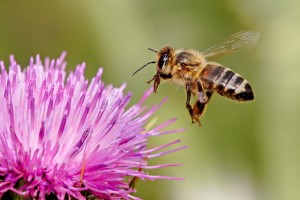
Are pesticides behind massive bee die-offs?

Some of you may recall the excellent bee reporting Tom Philpott did for Grist last year. Here he is again interpreting the Purdue study for Mother Jones.

Excerpt:

No one disputes that neonics are highly toxic to bees. But Bayer insists—and so far, the EPA concurs—that little if any neonic-laced pollen actually makes it into beehives, and that exposure to tiny amounts has no discernible effect on hive health. Bayer also claims that bees don’t forage much on corn pollen.

The Purdue study calls all of this into question. The researchers looked at beehives near corn fields and found that bees are “exposed to these compounds [neonics] and several other agricultural pesticides in several ways throughout the foraging period.” Contradicting Bayer’s claim that bees don’t forage much in cornfields, they found that “maize pollen was frequently collected by foraging honey bees while it was available: maize pollen comprised over 50% of the pollen collected by bees, by volume, in 10 of 20 samples.” They detected “extremely high” levels of Bayer’s clothianidin in the fumes that rise up when farmers plant corn seed in the spring. They found it in the soil of fields planted with treated seed—and also in adjacent fields that hadn’t been recently planted. And they found it in dandelion weeds growing near cornfields—suggesting that the weeds might be taking it up from the soil.

Most alarmingly of all, they found it in dead bees “collected near hive entrances during the spring sampling period,” as well as in “pollen collected by bees and stored in the hive.”

The “Zombie Fly”

Many of you may be asked about this new information on “The Zombie Fly.” Isn’t it interesting that this story would break in the media on the very same day that the Purdue Study is finally published? So far, no media attention to the Purdue Study. The suspicion of course is that this is one more attempt to divert attention away from pesticides.

We have known of the Phorid Fly for a long time and its occassional association with honeybees. It has been inconsequential. So if it is appearing in honeybee colonies in larger numbers, what is the explanation? I have pondered this and here is what I think may be the reason.

The Iowa story of a month ago documented the biologist who had been monitoring the population of native bees and had observed an 80% drop in their populations in the last 10 years. A survey of bumblebees has shown that 4 common U.S. species have declined dramatically with some on the verge of extinction. The likelihood is that others are declining as well and just haven’t been monitored yet, I spoke over Christmas with a friend who monitors bumblebees and she reports an absence of many species right here in Colorado.

The primary host of the Phorid Fly is bumblebees, If you remove that host, what will the fly do? Look for an alternate host of course, and since the bumblebee and native bee population has been decimated, it shifts to what had been only an occassional host, the honeybee, in a desperate effort to survive. The honeybees are still out there because beekeepers have gone to great efforts to keep colonies alive. In other words, that population is being artificially maintained. If it weren’t for the beekeeepers the honeybee population would be disappearing along with the bumblebees and other native pollinators.

If indeed the Phorid Fly is appearing on honeybees in greater numbers, I believe the most plausible explanation may be that this is one more symptom of the impoverishment of the environment by pesticides, As they spin this story at us to take the focus away from pesticides we need to spin it right back at them.

Tom Theobald

New Purdue University study

Multiple Routes of Pesticide Exposure for Honey Bees Living Near Agricultural Fields Christian H. Krupke, Greg J. Hunt, Brian D. Eitzer, Gladys Andino, Krispn Given

Abstract:

Populations of honey bees and other pollinators have declined worldwide in recent years. A variety of stressors have been implicated as potential causes, including agricultural pesticides. Neonicotinoid insecticides, which are widely used and highly toxic to honey bees, have been found in previous analyses of honey bee pollen and comb material. However, the routes of exposure have remained largely undefined. We used LC/MS-MS to analyze samples of honey bees, pollen stored in the hive and several potential exposure routes associated with plantings of neonicotinoid treated maize. Our results demonstrate that bees are exposed to these compounds and several other agricultural pesticides in several ways throughout the foraging period. During spring, extremely high levels of clothianidin and thiamethoxam were found in planter exhaust material produced during the planting of treated maize seed. We also found neonicotinoids in the soil of each field we sampled, including unplanted fields. Plants visited by foraging bees (dandelions) growing near these fields were found to contain neonicotinoids as well. This indicates deposition of neonicotinoids on the flowers, uptake by the root system, or both. Dead bees collected near hive entrances during the spring sampling period were found to contain clothianidin as well, although whether exposure was oral (consuming pollen) or by contact (soil/planter dust) is unclear. We also detected the insecticide clothianidin in pollen collected by bees and stored in the hive. When maize plants in our field reached anthesis, maize pollen from treated seed was found to contain clothianidin and other pesticides; and honey bees in our study readily collected maize pollen. These findings clarify some of the mechanisms by which honey bees may be exposed to agricultural pesticides throughout the growing season. These results have implications for a wide range of large-scale annual cropping systems that utilize neonicotinoid seed treatments.

Boulder County Commissioners acknowledge bees in Cropland Policy document

Here’s the language regarding pollinators and pesticides that the Boulder County Commissioners voted to include in the new Cropland Policy document on December 20th.

9.13
“Pollinators, especially bees, are vital to agriculture in Boulder County. Maintaining healthy pollinator populations requires cooperation between farmers, ranchers, bee keepers, and the county. The county shall provide opportunities for dialogue and cooperation between all parties. In the event that any pesticides or practices are linked with Colony Collapse Disorder, Boulder County will work with all involved to eliminate the impact possibly including a ban on a practice or pesticide.

Monsanto, Bayer and Dow face the Permanent People’s Tribunal

The level of concern is rising.

The world’s major agrochemical companies, Monsanto, Dow, Bayer, Syngenta, DuPont and BASF, will face a public tribunal in early December accused of systematic human rights violations.

They are accused of violating more than 20 instruments of international human rights law through promoting reliance on the sale and use of dangerous and unsafe pesticides including endosulfan, paraquat and neonicotinoids.

Read the article in full at The Ecologist.

Tom Theobald’s Corner

Founding member Tom Theobald speaks out about the EPA and clothianidin.

Upcoming Meetings and Events

Turn Off Bee Swarm